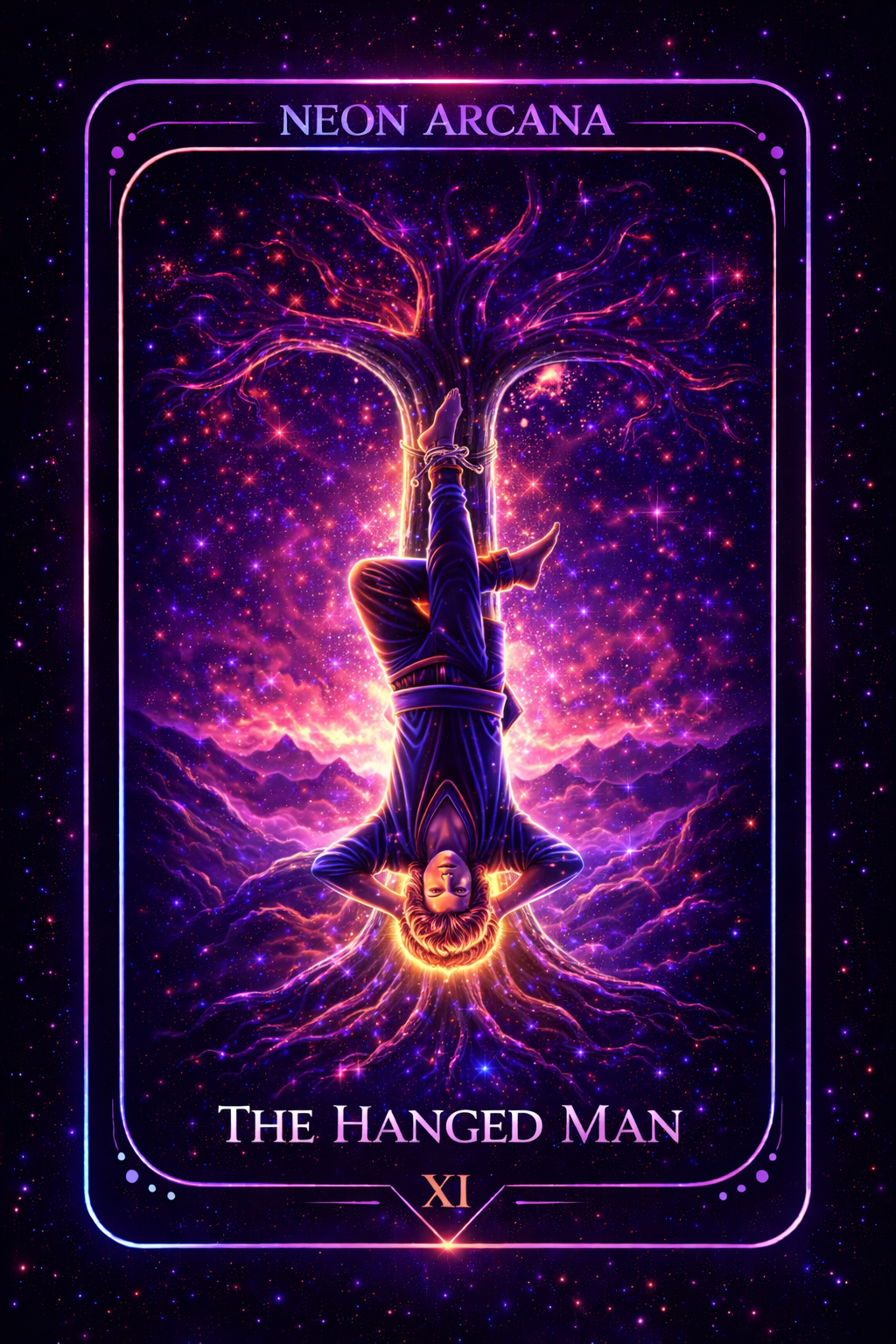
The Hanged Man is a pause with purpose. It asks you to stop forcing outcomes, shift your perspective, and let a new solution reveal itself. This card is about surrender, patience, and choosing a different angle instead of repeating the same push.
Upright
- Pause
- New perspective
- Surrender
- Patience
- Letting go
- Reframing
- Inner clarity
- Sacrifice for growth
Shadow
- Stagnation
- Victim mindset
- Avoidance
- Indecision
- Procrastination
- Martyrdom
- No boundaries
- Waiting without action
How to read this card
The Hanged Man arrives when your usual strategy stops working. You can push harder — but that only tightens the knot. This card points to a wiser move: pause, breathe, and see the situation differently. In traditional imagery the figure is suspended, calm, suggesting a choice rather than punishment. The message is not “do nothing forever.” It’s “stop forcing what isn’t ready.” Often, clarity appears the moment you release control: when you stop arguing, stop chasing, stop trying to win. The Hanged Man teaches that some progress happens inside first — perspective, acceptance, and a clean decision about what you will (and won’t) carry forward.
How to read The Hanged Man in a spread
- Past position: you were pulled into a delay; it changed how you see things.
- Present position: pause and observe; forcing the issue will backfire.
- Advice position: surrender one control point; choose a new perspective and simplify.
- Outcome position: insight and a better path after a strategic pause.
- Love: stop chasing certainty; give space and notice what’s true without pressure.
- Work: step back from urgency; rethink the plan, timeline, or offer.
- Money: avoid impulsive moves; review and restructure before acting.
- Shadow reading: don’t confuse surrender with avoidance — set a deadline for your pause.
Real-life examples
- You keep repeating the same argument: you stop, listen, and change the question.
- A project is stuck: you pause the launch and rebuild the simplest working version.
- You feel anxious about a relationship: you stop chasing and watch actions, not words.
- You’re overworking: you rest on purpose and return with a clearer priority.
- A decision feels impossible: you remove one option and see what relief appears.
- You can’t “make” someone choose you: you let go and reclaim your dignity.
Questions to ask yourself
- Where am I forcing something that isn’t ready?
- What perspective am I refusing to consider?
- What happens if I stop chasing control for 24 hours?
- What am I afraid will happen if I let go?
- What is the simplest next step — after I pause?
- What am I sacrificing, and is it actually worth it?
- What deadline will I set so my pause doesn’t become avoidance?
24-hour practice
- Choose one area to stop forcing (messages, pressure, urgent decisions).
- Write the situation from the other person’s perspective in 8–10 lines.
- Do one quiet reset: walk, gym, sleep, or a clean hour without phone noise.
- Define a pause window (e.g., 48 hours) and what you will review after it.
- Make one small correction: simplify, remove a step, or change the question.
The Hanged Man teaches that the fastest progress sometimes comes from not pushing. When you pause with purpose, perspective changes — and the right move becomes obvious. The core message: stop forcing, shift the angle, and let clarity arrive.