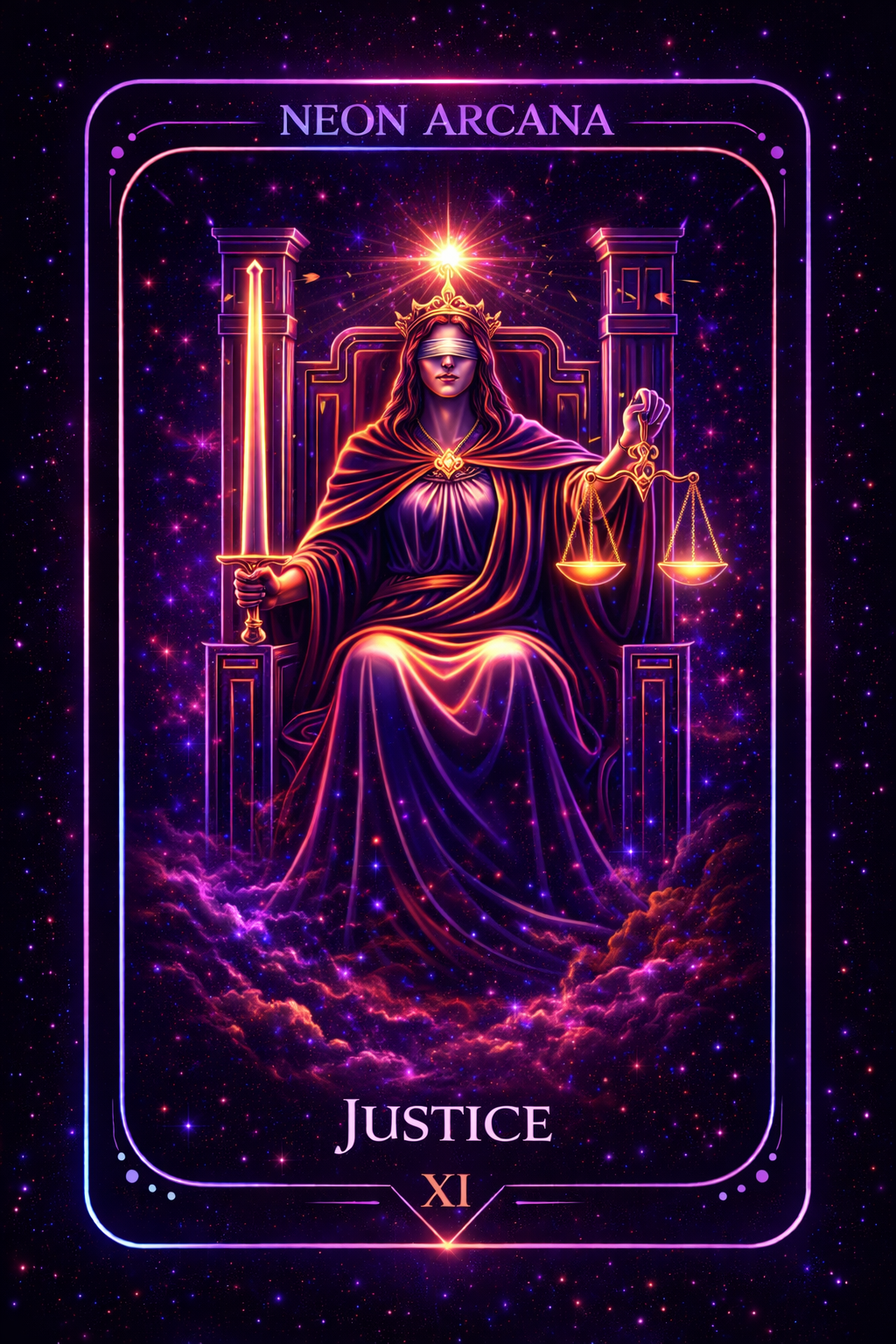
Justice is truth, balance, and cause-and-effect. It asks you to look at the facts, take responsibility for your choices, and make the clean, fair decision — even if it’s uncomfortable. This card is about clarity, integrity, and consequences.
Upright
- Truth
- Fair decision
- Accountability
- Balance
- Integrity
- Clear boundaries
- Contracts
- Making it right
Shadow
- Bias
- Avoiding responsibility
- Unfairness
- Self-justification
- Legal/contract trouble
- Harsh judgment
- Dodging the truth
- Imbalance
How to read this card
Justice appears when life is asking for alignment. Not perfection — alignment. It’s the moment where excuses stop working and only truth remains: what happened, what you chose, what you owe, what you deserve, and what must be corrected. This card often shows up around decisions, negotiations, boundaries, and situations where fairness matters. Justice is not about punishment; it’s about accuracy. If you’ve acted with integrity, it supports you with clean results. If you’ve been avoiding reality, it brings the mirror. The fastest way through Justice is simple: tell the truth, own your part, and choose the action that restores balance.
How to read Justice in a spread
- Past position: a choice you made set the current outcome — review it honestly.
- Present position: you need facts, not feelings; decide with clarity and fairness.
- Advice position: take responsibility, set boundaries, and put everything in writing if needed.
- Outcome position: consequences and resolution; fairness wins when you stay clean.
- Love: truth talks, clear agreements, and accountability; avoid games and half-truths.
- Work: contracts, policy, leadership decisions; do what’s correct, not what’s popular.
- Money: handle debts, taxes, paperwork; balance the books and reduce risk.
- Shadow reading: watch for blame, bias, or hiding details; it will backfire.
Real-life examples
- A relationship conflict: you name the real issue and propose a fair agreement.
- A work dispute: you document facts, define scope, and confirm everything in writing.
- A refund/complaint: you respond calmly, offer a clear solution, and close the loop.
- You feel guilty: you correct one thing instead of drowning in self-judgment.
- You’re judging someone: you check what you know vs. what you assume.
- A big decision: you choose the clean option that you can defend later with facts.
Questions to ask yourself
- What are the plain facts here (not my story about them)?
- What is my responsibility in this situation?
- What boundary must be stated clearly?
- What decision would I respect myself for in a year?
- Where am I being biased or emotionally reactive?
- What needs to be put in writing or made explicit?
- What is the fairest outcome for everyone involved?
24-hour practice
- Write the facts in 10 lines: what happened, what you want, what you can prove.
- Make one clean correction (apology, repayment, clarification, boundary).
- Review one agreement (deal, task, relationship rule) and make it explicit.
- Remove one area of chaos: paperwork, messages, finances, commitments.
- Choose one fair decision and act today — without drama.
Justice brings clarity and resolution through truth and accountability. When you stop hiding from reality and choose the clean, fair action, balance returns fast. The core message: tell the truth, own your part, and make it right.